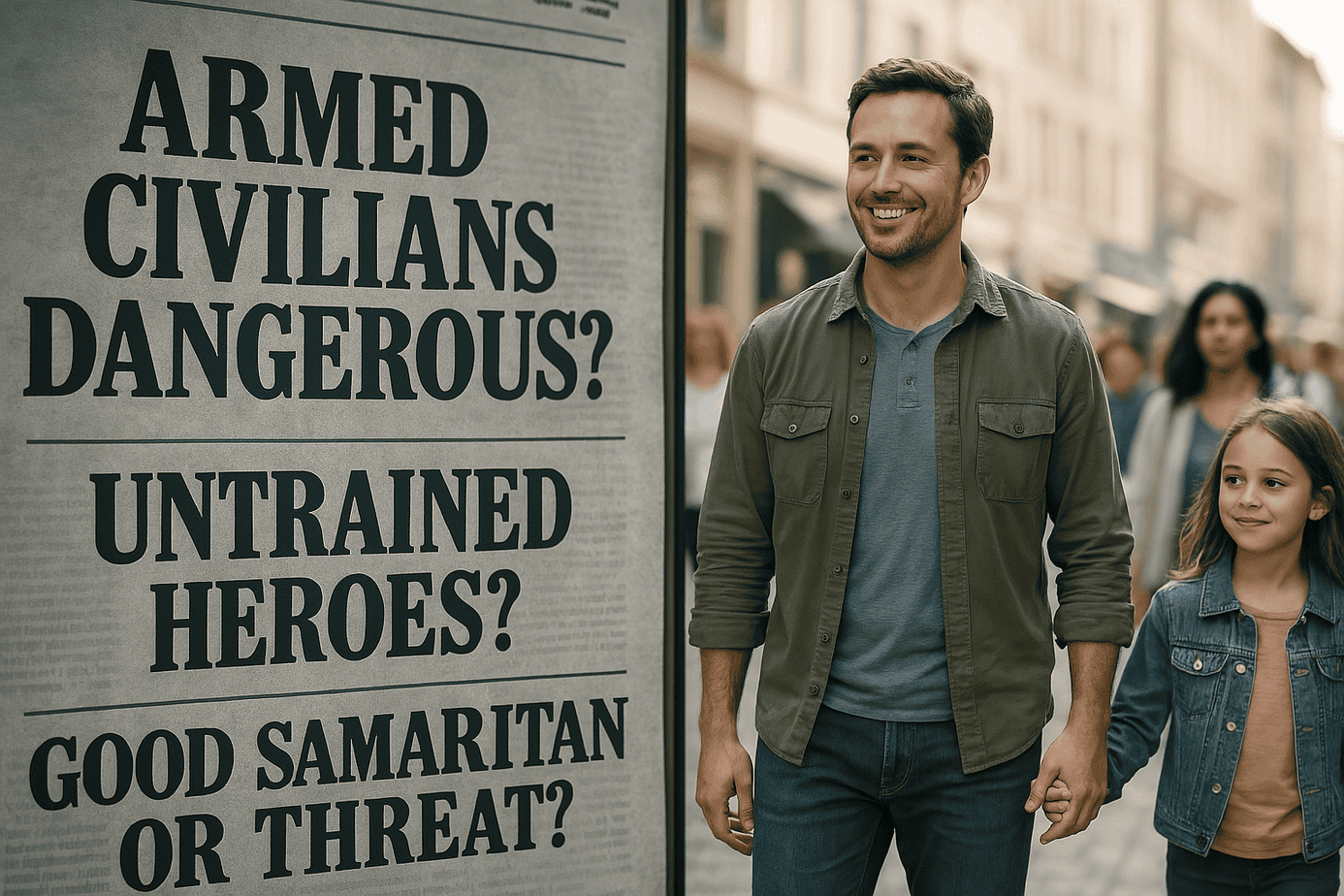
Whenever an armed civilian stops an active shooter, the story spreads fast. So do the doubts.
People often ask:
- What if they shoot the wrong person?
- What if they get in the way of police?
- What if the attacker takes their gun?
These are valid concerns. But when you look at actual data from real-world incidents, those fears don’t hold up.
What the numbers say
A 2025 study reviewing 179 active shooter incidents where armed citizens intervened found something striking:
- Not a single armed civilian accidentally killed the wrong person.
- Their weapons were never taken from them.
- They didn’t interfere with the police.
Compare that to law enforcement: in those same incidents, officers mistakenly shot the wrong person in four cases, including three fatalities. That’s a 2.5% rate for officers versus 0% for civilians.
They’re stopping more attacks than we think
Most people think armed citizens rarely stop active shooters. That’s because the FBI’s public data only counted a small fraction, just 4.6% of cases.
But new research shows that’s way off.
From 2014 to 2022, armed citizens actually stopped 35.7% of active shooter events in places where carrying is allowed. That number jumps even higher in 2023, over 40%.
Why the gap? Many times, the attacker is stopped before police arrive or dies by suicide during the confrontation, so those cases aren’t always included in government stats.
Are civilians effective?
The numbers say yes.
When an armed citizen stops the shooter, total casualties are 44% lower on average. That includes a 49% drop in deaths and a 41% drop in injuries.
And they’re doing it without creating chaos. Civilians aren’t shooting the wrong people, they’re not getting disarmed, and they’re not getting in the way.
What it really means
This isn’t about replacing law enforcement; it’s about time.
Most of these attacks end in under five minutes. Armed civilians are often the only ones close enough to respond fast enough.
When they’re trained and equipped, they can end the threat before more lives are lost.
Final thought
The idea that armed citizens are a liability just isn’t backed up by the data. If anything, they’re showing up, stepping in, and saving lives, more often and more effectively than most people realize.
Need help building a safe, trained response in your home, school, church, or workplace?
Risk Strategy Group can help with assessments, training, and custom security policies that work in the real world.
Contact us to learn more.

Written by
Cody Martin
Cody brings over 20 years of federal law enforcement, training, and physical security expertise. He has advised and trained more than 20 Fortune 500 firms, along with schools, churches, government agencies, and private individuals across the country. As a federal agent, Cody served as Threat Management Coordinator for a three-state division, Officer Survival Subject Matter Expert at National Headquarters, and developed the agency's national Improvised Explosive Device Recognition and Response program from the ground up. He led threat management training across four states and served on a presidential protection detail. Cody holds a BS and a Master of Science in Criminal Justice from Tarleton State University. Notable work includes creating and delivering the national IED Recognition and Response training program for a federal law enforcement agency, serving as Officer Survival and Firearms Subject Matter Expert at National Headquarters, Threat Management Coordinator overseeing instructors across Texas, Oklahoma, and Arkansas, serving on a presidential protection detail, conducting risk assessments and security plans for Fortune 500 companies and ultra-high-net-worth individuals, and publishing in RECOIL OFFGRID, RECOIL CONCEALMENT, and SKILLSET on situational awareness, EDC, and concealed carry.